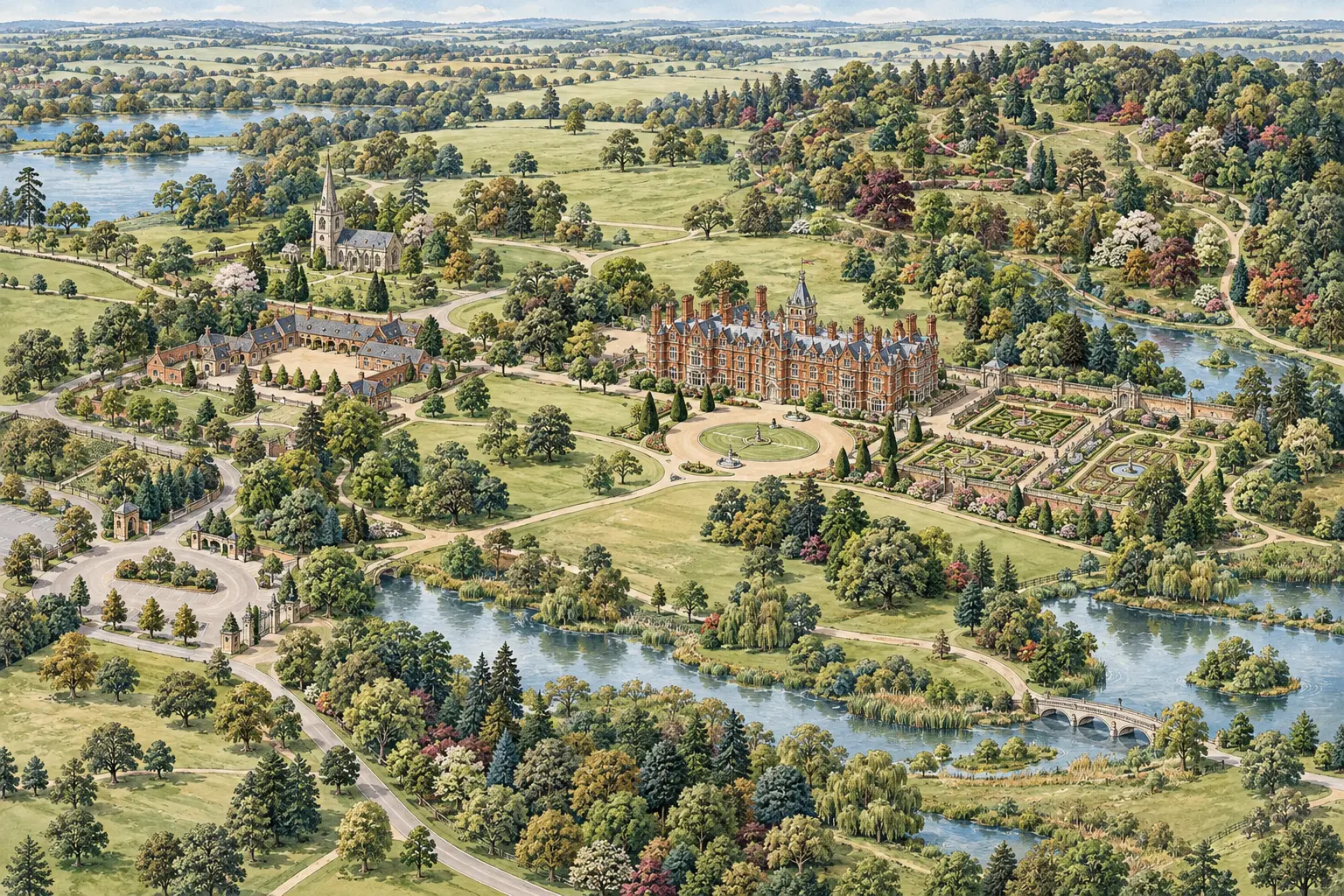
A film, article, search result, press feature or social story creates curiosity.
THE LIVING ESTATEPRIVATE SANDRINGHAM VISION STUDY
Exploratory · not approved
PRIVATE NORTH STAR · VISITOR GROWTH + STORYTELLING
A living Estate deserves a living relationship with its visitors.
What if Sandringham's stories did more than explain a place once people arrived — and became the reason they discovered it, chose to visit, noticed more while there, shared what mattered and found a reason to return?
SANDRINGHAMLIVING
ESTATESTORY SYSTEM
ESTATESTORY SYSTEM
STABLES
GENERATIONS
STEWARDSHIP
SEASONS
EXPERIENCES
1977 → 2027Fifty years of public welcomeAnniversary opportunity
OBJECT → STORYThe Stables as first proofContained + measurable
VISIT → RETURNMake one visit open the nextMarketing growth loop
Not another heritage website.
A platform that makes stories work harder.
Sandringham already has the place, history, working Estate, seasonal change and visitor experiences. The opportunity is to connect those assets into one editorial and digital system that can support campaigns, interpretation, media, participation and measurable visitor journeys.
THE GROWTH LOOP
Every story should know what happens next.
Marketing does not stop at reach. Interpretation does not start only at the gate. The system connects the whole visitor relationship.
A focused story page turns curiosity into a clear reason to visit and a route to booking.
The physical Estate remains the main event — interpretation helps people notice more.
Visitors can respond, remember, contribute or simply go deeper when appropriate.
Approved stories are designed to travel naturally across social, email and media.
Seasonal change, new chapters and family memory create a genuine reason to come back.
ONE PLATFORM · THREE QUESTIONS
Alice should be able to see the idea from the chair she is sitting in.
Select a lens. The same platform has to make sense emotionally to a visitor, commercially to marketing and responsibly to the Estate.
MARKETING VALUE
One approved story becomes a campaign system — not one post.
A strong story can power a landing page, social hook, film, email chapter, press angle, on-site prompt and measurable bridge to booking, then keep working after the visit.
CAMPAIGN UNIVERSE
Five chapters. One coherent Estate story.
These are opportunities to test with Alice, not claims of approval. The Stables is already developed enough to act as the first proof.
Stories in Motion
Turn Royal Vehicles, carriages and the Sandringham Fire Engine into object-led stories people notice, remember and share.
“Before you read the label, find the detail that tells you how this object moved.”
Visitor
A richer physical visit with optional digital depth — never a screen for the sake of a screen.
Marketing
A highly visual campaign with detail reveals, short-form films, object stories, social cut-downs and trackable visit prompts.
Estate
A contained pilot with approved facts, permissions, one review loop and a clear baseline before anything scales.
object storyshort filmsocial revealon-site promptQR companionpost-visit memory
WORKING PROOFONE OBJECT · FOUR DEPTHS
01NOTICEthe detail
02DISCOVERthe approved story
03LOOK CLOSERoptional depth
04REFLECTmake it memorable
NEW EVIDENCE FROM THE VISITOR MAPThe Estate is already a network.
The Estate is already a network.
The digital opportunity is to make that network adaptive.
The printed visitor map already separates the public experience into Courtyard, Discover and Gardens, with twenty-five named destinations. That gives the Living Estate concept a stronger foundation: this does not need to invent a visitor structure from scratch.
Enough granularity for real route planning, story layers and time-based recommendations.
Food can become contextual to a route rather than a generic website link.
The brochure already promotes year-round benefits, discounts, access and updates — a natural future account layer.
Anniversary memories, seasonal highlights and object stories can sit over the permanent map without changing physical signage.
NORTH STAR · MADE TANGIBLE
A living relationship, expressed through one connected visitor system.
The campaign platform, spatial layer, Stables proof, visitor companion and measurement framework are now parts of the same proposition rather than separate demonstrations.
“Technology disappears when it is not useful. The Estate remains the interface.”Private illustrative concept · not commissioned or approved by Sandringham Estate · mapping is not survey accurate
THE MEDIA ENGINE
Build once. Publish intelligently across the journey.
The platform should help Alice turn one approved story into the right format for the right channel without losing provenance or context.
One arresting detail or question that works on social without flattening the history.
A short approved film or audio story that turns curiosity into desire to experience the place in person.
Fact sheet, approved imagery, source notes, key dates and a clearly framed story angle in one media-ready pack.
A reason to return to the story: next season, a new object, an anniversary memory or a related experience.
A physical prompt and optional QR that deepens the real visit without making a phone compulsory.
Every claim keeps its source, status, rights and approval pathway attached behind the scenes.
MEASURE THE THING WE ACTUALLY CARE ABOUTAttention is useful.
Attention is useful.
Movement is better.
No invented targets. Alice first defines the business objective and baseline; the pilot then measures whether the experience actually changes behaviour.
Track campaign traffic, story-page engagement and outbound booking clicks instead of treating awareness as the finish line.
Compare the pilot area before and after interpretation: what people notice, where they pause and which deeper layers they choose.
Measure consented memory contributions, email opt-ins and returning participation where Sandringham chooses to invite it.
Package approved stories so press and creators can understand them quickly, while keeping evidence, rights and context intact.
WORKING MEASUREMENT VIEWILLUSTRATIVE · NO LIVE SANDRINGHAM DATA
CampaignReach → visit intent
StoryEngagement → booking click
On siteNotice → dwell → depth
RelationshipSubscribe → return
ILLUSTRATIVE PILOT DASHBOARDDecision evidence, not vanity metrics.
NO LIVE SANDRINGHAM DATABEFOREBaseline
Observe the existing visitor journey before changing it.
DURINGPilot
Track agreed behaviours through campaign, story and on-site touchpoints.
AFTERDecision
Scale, refine or stop based on what actually moved.
Discovery
qualified visitstory depthbooking bridge
On site
noticedwellgo deeper
Relationship
remembersubscribereturn
SCALE WITHOUT THE BIG-BANG REDESIGNProve one thing.
Prove one thing.
Then earn the right to expand.
Stables exemplar
One to three object stories. Establish the quality, governance and measurement model.
Generations
Use the 1977–2027 moment to test consent-led family memory and anniversary storytelling.
Estate story atlas
Connect approved stories across House, Gardens, experiences, working Estate and stewardship.
Seasonal campaign engine
Turn real change across the Estate into repeat reasons to follow and return.
Living archive
If useful, retain approved stories, sources and memories as an evolving long-term interpretation layer.
A POSSIBLE WORKING MODEL · TO DISCUSS WITH ALICE
You do not need a huge agency machine to test whether this is valuable.
Keep ownership and approval where they belong, while making the prototype fast enough to see and react to.
Define the business objective, audiences, campaign moments, tone, channels and what success would look like.
Turn the opportunity into an experience system, working digital product, campaign architecture and measurable prototype.
Where useful, participants can add carefully reviewed writing, photography, sound, film or memory-led creative response.
Archive, photography, film, accessibility, interpretation or technical specialists can be brought in only where the agreed pilot needs them.
WHAT WE WOULD NEED FROM SANDRINGHAMVery little to start.
Very little to start.
But the right little.
A useful pilot should reduce internal risk, not create a new programme of work before anyone knows whether the idea is valuable.
Agree what the first pilot needs to move: awareness, visit intent, on-site engagement, experience conversion, repeat visits or another priority.
Choose one to three Stables objects or another tightly defined starting point rather than trying to interpret the entire Estate.
Identify where facts, object records, dates, archive material and corrections come from — and who can verify them.
Agree what may be photographed, filmed, quoted, reproduced, shared internally and eventually published.
Name the smallest sensible approval path so creative work can move quickly without bypassing Estate governance.
Observe the current Stables experience before intervention so any claimed improvement has something real to compare with.
THE INTERNAL DECISION THIS SHOULD ENABLEIs there enough evidence and visitor value to approve a real pilot?
ROYAL CONTEXT · CREATIVE DISCIPLINE
The more prestigious the access, the more careful the system should become.
No implication of Royal endorsement, involvement or approval unless explicitly agreed.
No private or restricted material enters a prototype merely because access was granted.
Facts, memory, participant interpretation and marketing copy remain visibly distinguishable.
Rights, permissions, provenance and approval status travel with every reusable media asset.
Exploratory work remains private and unindexed until Sandringham decides otherwise.
Do not ask Alice whether she likes the website.
Ask what Sandringham needs the platform to move.
More first-time visits?More repeat visits?More conversion into paid experiences?More media visibility?Stronger anniversary storytelling?Deeper visitor understanding?
Once one primary outcome is chosen, the Stables pilot can be designed to test it properly rather than trying to prove everything at once.